


A group of Republican senators is warning US bank regulators that a little-known capital rule could effectively keep banks out of Bitcoin, even as Congress moves to give traditional financial firms a larger role in digital asset markets.
In a May 27 letter to Federal Reserve Vice Chair for Supervision Michelle Bowman, FDIC Chair Travis Hill, and Comptroller of the Currency Jonathan Gould, six senators urged the agencies to build a new capital framework for on-balance-sheet digital asset activities.
Their target is Basel’s 1,250% risk weight for assets such as Bitcoin, which they argue functions as a de facto ban on banks holding crypto.
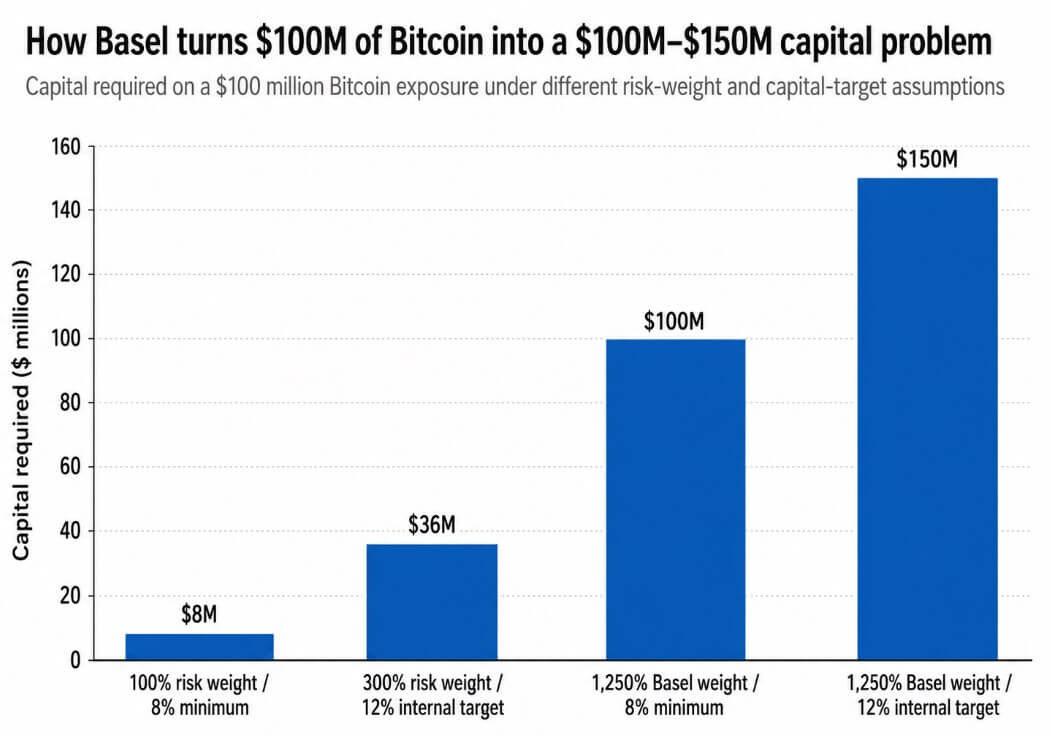
A 1,250% risk weight multiplied by the 8% minimum capital requirement equals a 100% capital allocation, meaning a bank holding $100 million in Bitcoin needs at least $100 million in capital against it.
For banks that manage to meet internal CET1 targets above the regulatory floor, the burden climbs further. A bank with a 12% internal capital target would need $150 million in capital for that same $100 million exposure, requiring roughly $18 million in annual net profit to clear a 12% ROE hurdle.
Normal custody, trading, or client-service economics rarely generate returns at that threshold, leaving a bank legally authorized to hold Bitcoin but financially unable to justify doing so.
Why this lands now
The Senate Banking Committee advanced the CLARITY Act on May 14 by a 15-9 vote, sending it to the Senate floor.
If passed, the bill would give banks a clearer statutory role in digital asset markets, but the senators argue that legislative permission without capital efficiency leaves banks holding a permission slip they cannot afford to use. A bank can be legally authorized to hold Bitcoin and still be structurally prevented from doing so by a capital charge that makes the position uneconomic before the first trade.
The three regulators the letter addresses have each moved toward crypto permissiveness since early 2025.
The OCC reaffirmed in March 2025 that national banks may engage in crypto custody, stablecoin-related activities, and distributed-ledger payment functions, while removing the prior supervisory non-objection requirement.
The FDIC followed that same month, rescinding its notification requirement and allowing FDIC-supervised institutions to pursue permissible crypto activities without prior approval.
The Fed withdrew its guidance on crypto assets and dollar tokens in April 2025, framing the move as support for innovation.
All three agencies opened the door to crypto activity and left the Bitcoin capital question untouched.
The senators found their sharpest argumentative foothold in a March 2026 interagency FAQ on tokenized securities.
| Regulator | Recent crypto-friendly move | What it allowed or eased | What remains unresolved |
|---|---|---|---|
| OCC | March 2025 guidance | Crypto custody, stablecoin activity, DLT payments; removed non-objection requirement | Capital treatment for bank-held Bitcoin |
| FDIC | March 2025 guidance | Permissible crypto activities without prior FDIC approval | Capital treatment for direct crypto exposure |
| Fed | April 2025 withdrawal | Pulled prior crypto/dollar-token guidance | Capital treatment for on-balance-sheet Bitcoin |
| Fed / FDIC / OCC | March 2026 FAQ | Tokenized securities generally treated like underlying securities | Whether that logic applies to native cryptoassets |
The joint guidance from the Fed, FDIC, and OCC held that eligible tokenized securities should generally receive the same capital treatment as their non-tokenized equivalents, and that the technology used to record or transfer ownership should not determine capital allocation.
If a tokenized Treasury is treated like a Treasury because the underlying risk profile governs its treatment, the logic should extend to Bitcoin, and the asset’s volatility and operational risks are measurable and can support a calibrated framework.
The March 2026 guidance covers eligible tokenized securities, and the senators are pressing regulators to carry the same technology-neutral logic forward to native digital assets.
The prudential case for the rule
The Fed, FDIC, and OCC’s 2023 joint statement noted price volatility, legal uncertainty regarding custody and ownership rights, contagion from exchange and counterparty failures, governance weaknesses in crypto networks, and operational risks associated with open or decentralized infrastructure.
The Basel standard was built around those risks after the 2022 crypto collapse exposed how quickly losses could spread to interconnected institutions.
A dollar-for-dollar capital charge reflects a genuine judgment that Bitcoin’s risk profile does not resemble the assets that populate traditional bank balance sheets.
The senators argue that the risks of volatility, custody complexity, and operational exposure are quantifiable, and a calibrated capital framework can address them without requiring capital equal to or greater than the exposure itself.
The Basel Committee agreed in November 2025 to expedite a targeted review of elements of its cryptoasset standard, and reported progress on that review in February 2026.
Basel Chair Erik Thedéen has said the global crypto rules for banks need to be reworked after the US and UK both declined to implement the current framework.
A coalition of major financial industry groups wrote to Basel in August 2025, arguing that the standard would make meaningful bank participation uneconomical and requesting a pause and revisions.
The senators are pressing US regulators to act at a moment when the international architecture underpinning the 1,250% treatment is under open review.
Two paths from here
If regulators respond by proposing a calibrated framework for liquid digital assets instead of the blanket Basel weight, the capital required on $100 million of Bitcoin exposure could fall from the current $100 million-$150 million range to something closer to $8 million-$36 million under a 100%-300% risk-weight band and standard capital targets.
| Scenario | Capital treatment | Bank role in crypto | Likely market effect |
|---|---|---|---|
| Calibrated framework | 100%-300% risk-weight band; $8M-$36M capital on $100M exposure | Banks can hold inventory, support market-making, custody, prime brokerage and structured products | More institutional liquidity; tighter spreads; banks become balance-sheet participants |
| Basel rule remains | 1,250% risk weight; $100M-$150M capital on $100M exposure | Banks mostly provide custody, settlement and services, but avoid direct BTC exposure | Bitcoin access remains routed through ETFs, nonbanks and offshore venues |
At that level, bank market-making, custody, prime brokerage, and structured crypto products become viable lines of business. Institutional liquidity improves, spreads compress, and banks move from service providers to balance-sheet participants.
If regulators keep 1,250% treatment as the practical standard for native crypto on-balance-sheet exposure while continuing to open other pathways, banks would continue offering custody and settlement, while direct Bitcoin exposure stays with nonbanks and ETF wrappers.
US-traded spot Bitcoin ETFs already saw roughly $4.4 billion in outflows through May 15 to June 3, showing that institutional access to Bitcoin has routed around bank balance sheets.
That channel will deepen if the capital rule stays intact.
The letter does raise the political cost of inaction while Congress is actively writing the market structure rules that will govern bank participation in digital assets for the next decade, and legal authorization to hold Bitcoin means little if the capital charge required to do so makes the position uneconomic from the first day it hits the balance sheet.
