

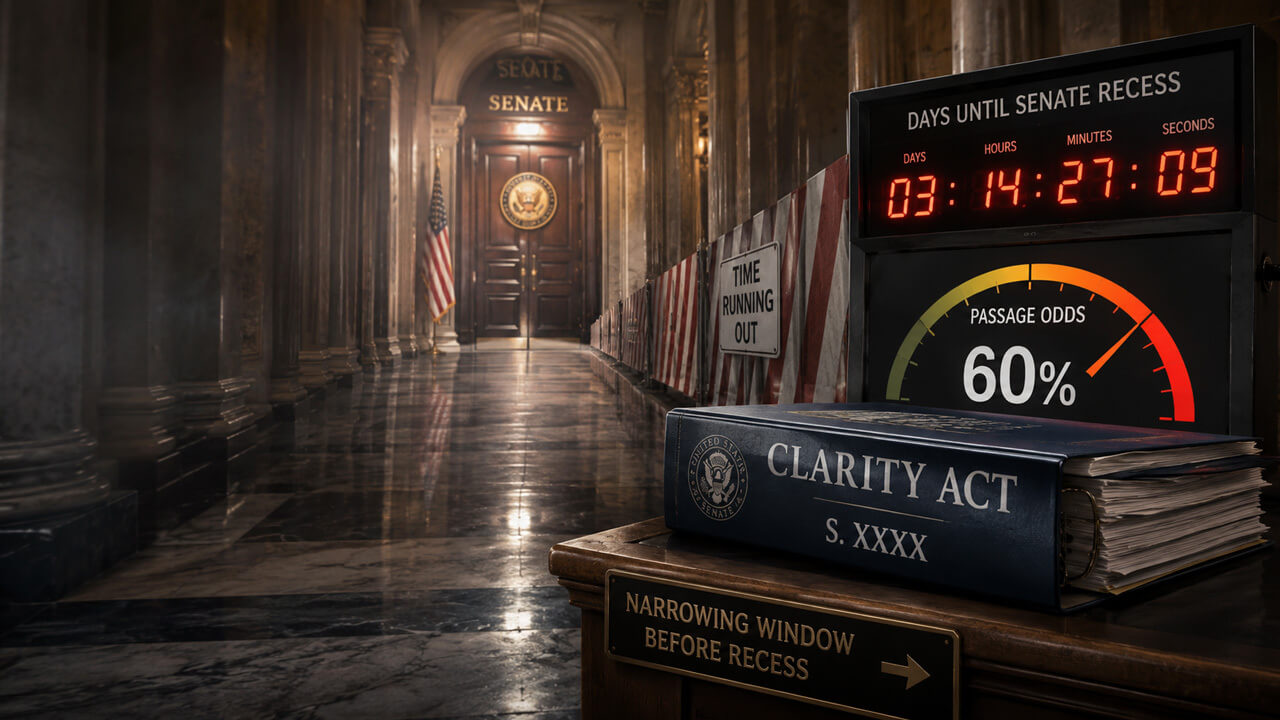
The CLARITY Act, the crypto industry’s biggest bill in Congress, is losing momentum just weeks after clearing a key Senate committee, raising the risk that Washington’s first major digital asset rulebook slips deeper into an election year.
Galaxy Digital lowered its estimate that the CLARITY Act will become law in 2026 to 60% from 75%, citing a shrinking Senate calendar and little visible progress on unresolved fights over ethics and illicit finance.
Notably, JPMorgan analysts issued a similar warning this week, saying the legislative window has narrowed as lawmakers move closer to the midterm elections.
The downgrade marks a reversal for a bill that recently appeared to have its clearest path yet. The CLARITY Act cleared the Senate Banking Committee on May 14 in a 15-9 vote.
The CLARITY Act is the crypto industry’s central legislative priority because it would create the first comprehensive federal framework for digital assets in the US.
Supporters say it would clarify when cryptocurrencies fall under the Securities and Exchange Commission (SEC) or the Commodity Futures Trading Commission (CFTC), replacing years of enforcement-driven policy with clearer rules for issuers, exchanges, and investors.
But the legislation still needs to pass the full Senate, be reconciled with House legislation, and receive the president’s signature.
That sequence is becoming harder to fit into a crowded summer schedule.
Senate calendar turns against the bill
In a recent note to clients, Galaxy explained that its revised estimate is based mainly on timing rather than a collapse in support for the bill.
Alex Thorn, the firm’s head of research, pointed out that the Senate is running out of usable days before the August recess, which is scheduled to begin at the end of July.
According to him, the bill faces several procedural steps before it can become law. This includes the fact that it must secure 60 votes in the Senate, go through floor debate and amendments, be aligned with a separate Senate Agriculture Committee text, and then move through the House.
This means the Senate Majority Leader John Thune would likely need to schedule floor time in July for that process to fit before lawmakers leave Washington.
However, the available window has narrowed over the past two weeks as the Senate lost time to a fight over the administration’s anti-weaponization fund, which consumed floor space during work on an ICE and Border Patrol funding package.
The chamber also failed to advance reauthorization of Section 702 of the Foreign Intelligence Surveillance Act in a 47-52 procedural vote, setting up another scramble before the surveillance authority lapses June 12.
That creates a practical problem for a bill that still needs bipartisan support. Senate leaders have little reason to spend a week of scarce floor time on legislation unless they believe the votes are ready.
The open issues remain substantial. Democrats led by Sen. Ruben Gallego have pushed for ethics provisions tied to conflicts of interest. Illicit finance hawks want stronger safeguards around money laundering and sanctions risks. The Senate Banking and Agriculture committees also still need to merge their approaches.
JPMorgan analysts led by Nikolaos Panigirtzoglou said the midterm calendar could delay progress on crypto market structure reform this year.
Meanwhile, the timing could also affect the final deal, because a compromise reached before the elections may look different from one negotiated afterward, when political incentives and control of Congress could shift.
Banks keep pressure on stablecoin yield
The calendar problem is colliding with the banks’ sustained fight over stablecoins, the digital tokens designed to track the dollar and move across blockchain networks.
For banks, the most sensitive question is whether crypto firms can offer yield on stablecoin balances.
Banking groups have warned that interest-like payments on digital dollars could pull money away from checking and savings accounts while avoiding the rules that apply to regulated banks.
CryptoSlate previously reported that the bill was intended to prohibit passive yield, meaning payments made simply for holding stablecoins. However, the legislation would still allow rewards tied to activity, such as payments, transactions, loyalty programs, and trading incentives.
The distinction could determine whether stablecoins remain payment and settlement tools or become substitutes for bank deposits.
Crypto firms have pushed for flexibility, arguing that activity-based rewards are part of payments innovation and consumer adoption.
The industry says overly strict limits would protect banks from competition and reduce the appeal of digital dollar products that can settle faster than traditional payment systems.
Banks counter that stablecoin issuers and crypto platforms should not be allowed to offer bank-like products without bank-like obligations.
In fact, an American Bankers Association (ABA)-sponsored survey recently stated that “consumers strongly support protecting local lending and the financial system from the risks associated with allowing interest-like rewards on stablecoins.”
That argument has gained political force as stablecoins grow into a larger part of digital finance and as major exchanges seek new ways to turn customer balances into payment activity, trading incentives, and yield-linked products.
Essentially, this dispute remains one of the major obstacles to advancing the legislation as bankers and crypto executives lobby for their own advantage.
What’s next for CLARITY Act?
Galaxy Digital stated that the bill’s path could improve if Senate leadership commits to floor time in early to mid-July, if lawmakers bridge the ethics and illicit finance disputes, and if the Banking and Agriculture committees produce a combined package ready for debate.
Those signals would show that the bill has both the votes and the calendar space needed to move.
Without them, the path likely shifts to September, when campaign politics and a crowded fall agenda could reshape the bill or push it into another Congress.
For now, the CLARITY Act remains alive but weakened. Its chances have fallen because the Senate has less time, the banks are still fighting over digital dollars, and the crypto industry has only a few weeks to prove the bill can clear Washington before election politics take over.
